
Our Secretary Lucie Millar Champions Integrated Education at Alliance Party Conference
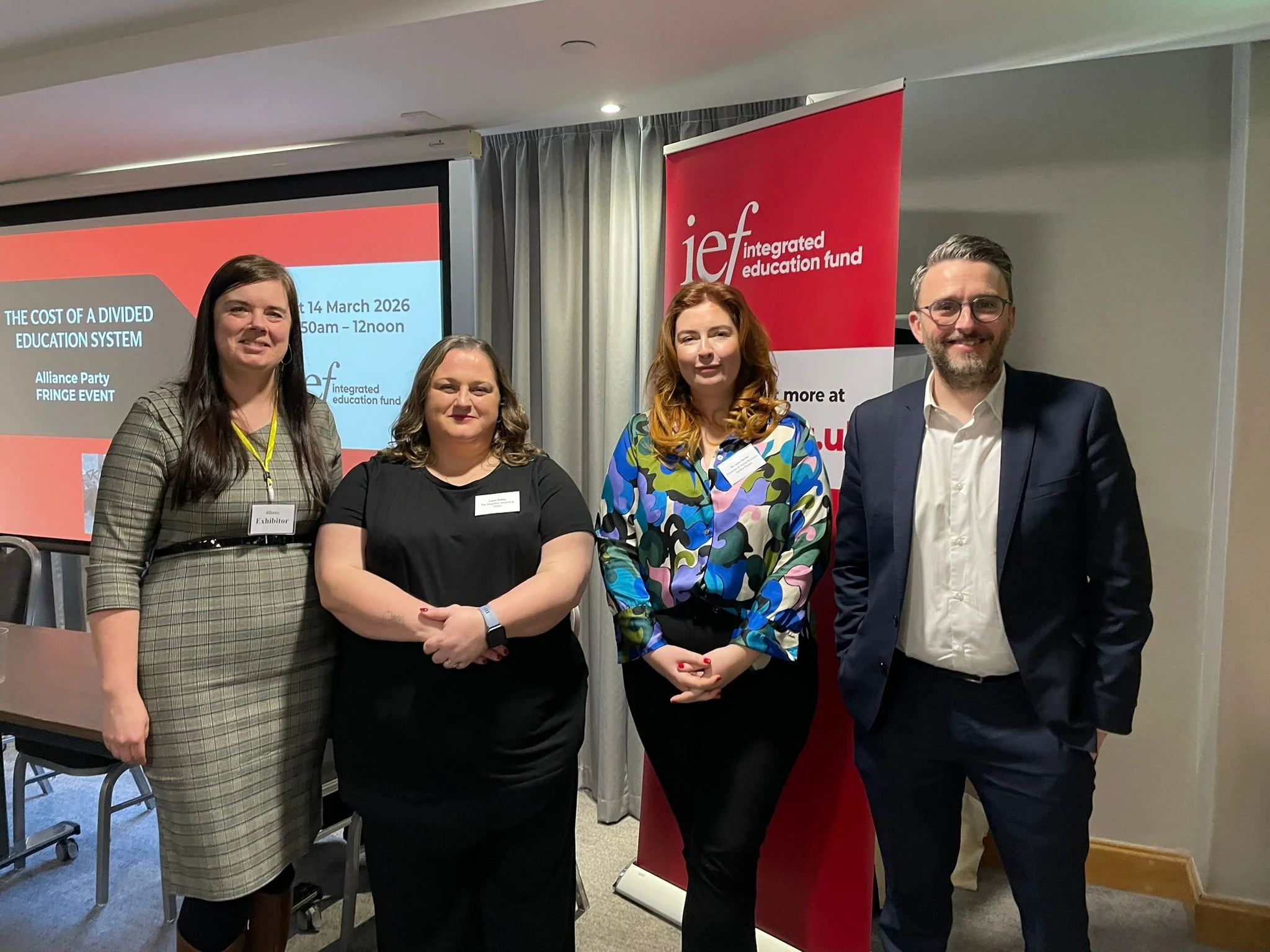
On 14 March 2026, Integrated AlumNI Secretary Lucie Millar joined a panel of leading education voices at the Alliance Party's 56th Annual Conference in Belfast, making the case for why integrated education matters — not just as a principle, but as a financial and social imperative for Northern Ireland's future.
Setting the Scene
The Alliance Party conference, held at the Crowne Plaza Hotel in Belfast under the theme "Hope Not Fear," brought together hundreds of delegates and featured a keynote address from party leader and Justice Minister Naomi Long. Among the packed programme of events was a fringe session hosted by the Integrated Education Fund (IEF), focused on the spiralling cost of Northern Ireland's divided education system and what can be done about it.
The event was introduced by IEF's Jessica Blomkvist, who set out the scale of the challenge: 70% of schools operating in financial deficit, an estimated £800 million maintenance and repair backlog, a £300 million deficit in the Education Authority budget, and a £200 million deficit in the wider education budget. The IEF, a charity supporting the growth of integrated education, hosted the session to spotlight research from the Transforming Education Project — a major series delivered by Ulster University, with 24 papers produced to date and a compilation volume launching on 24 March.
The Cost of Division
The centrepiece presentation came from Dr Matt Milliken, an independent researcher from Ulster University's Transforming Education project, who laid bare the financial and social cost of maintaining one of the most divided education systems in the world. Northern Ireland's schools divide children by community identity, gender, class, disability, and even language — with only around 8% of children currently attending integrated schools.
Dr Milliken's revised estimate put the annual cost of this division at £150 million — equivalent to £800,000 every single school day, or the salaries of 4,000 teachers. That figure represents 4% of the £3.6 billion draft education budget and could fund 20 new schools at a time when the school estate is crumbling. As he put it bluntly: separating children isn't worth "tuppence, let alone £150 million." An earlier Ulster University study had estimated the cost at £226 million per year, though Dr Milliken's revised figure of £150 million reflects updated data from the Department of Education.
Further statistics underscored the urgency. Some 40% of rural primary schools are currently below the threshold for sustainability. The Department of Education's own population forecasts indicate that student enrolment is projected to decrease by over 12% in the next decade, with 25,000 fewer young people aged 0–5 by 2047 — meaning schools will continue to close. Without intervention, these closures risk deepening the very divisions they should be dismantling.
Lucie's Voice: A Parent's Perspective
Following the presentation, Lucie Millar took her place on a panel alongside Dr Anne Devlin, an economist from the Economic and Social Research Institute (ESRI), and Nick Mathison MLA, Alliance Party chair of the Education Committee.
Lucie spoke powerfully as both an AlumNI representative and a parent. She has three children currently in the integrated sector, both attending and have attended a school that transformed to integrated status — a process she was personally involved in. Though not herself a past pupil of an integrated school, Lucie's passion for the movement runs deep, and her involvement in that transformation journey was a catalyst for her wider advocacy.
She spoke candidly about the generational impact of educational segregation. Many primary schools, she noted, were built as a result of displacement aligned with the Troubles in areas shaped by sectarian housing patterns. The divisions created then became self-reinforcing — not just in education, but rippling out into health outcomes, employment prospects, and community wellbeing.
Responding to the financial data, Lucie described the figures as "terrifying," arguing that the money spent on initiatives to bring children back together after years of separation would be far better invested in educating them together from the start. She painted a vivid picture of the reality facing schools today: children wearing coats in classrooms, old iron window frames that barely open, leaking roofs — all while spending at least 25 hours a week in buildings entrusted with their futures.
On the topic of parental choice — one of the four founding principles of integrated education — Lucie struck a balanced note. "Every school is a good school," she said, "but is every school the right school for your child and your family?"
A Lively Panel Discussion
The panel discussion that followed was wide-ranging and frank. Dr Anne Devlin highlighted how the financial pressures facing the Department of Education are only set to grow, with increasing numbers of migrant children, rising special educational needs, and a population that increasingly does not identify along traditional Catholic–Protestant lines.
Nick Mathison MLA did not hold back. He called the cost of a divided system "not acceptable" and argued that Alliance needs to take the issue of academic selection equally seriously, noting how class-based division feeds directly into community division. He advocated scrapping the current ministerial guidance on school transformation, a full legislative review of integrated education law, and the establishment of an independent Area Planning Commission — as recommended by the Independent Review of Education — to take difficult decisions about school closures and mergers out of the hands of politically constrained ministers.
The audience was engaged throughout, raising questions on governance reform, the role of churches in schools, religious education, and how the growing "others" category — those who don't identify as Catholic or Protestant — are served by the current system.
Why This Matters
Integrated education in Northern Ireland continues to grow, with 76 approved integrated schools now providing education to over 28,690 pupils. The UK Government has also backed the movement, announcing £2 million for integrated education at the 2025 Spending Review, with Northern Ireland Secretary Hilary Benn describing it as "reconciliation in action".
Yet significant barriers remain. Integrated AlumNI — a registered charity forming a network of past students, ambassadors, and campaigners — exists precisely to keep the pressure on and amplify the voices of those who have experienced the transformative power of learning together. Lucie Millar's presence on that panel, speaking from lived experience as both a parent and a community advocate, is exactly the kind of grassroots engagement that drives real change.
Get Involved
Integrated AlumNI welcomes anyone who shares the goal of advancing integrated education in Northern Ireland — past pupils, parents, educators, and supporters alike. If this blog has inspired you to add your voice to the movement, here's how you can get involved:
Join our network www.integratedalumni.org/membership
Talk to your MLA about integrated education and area planning reform.